Cicindela chinensis
| Distribution: | Asia |
| Size: | c.20mm body length |
| Diet: | Ants, flies, grasshoppers, caterpillars |
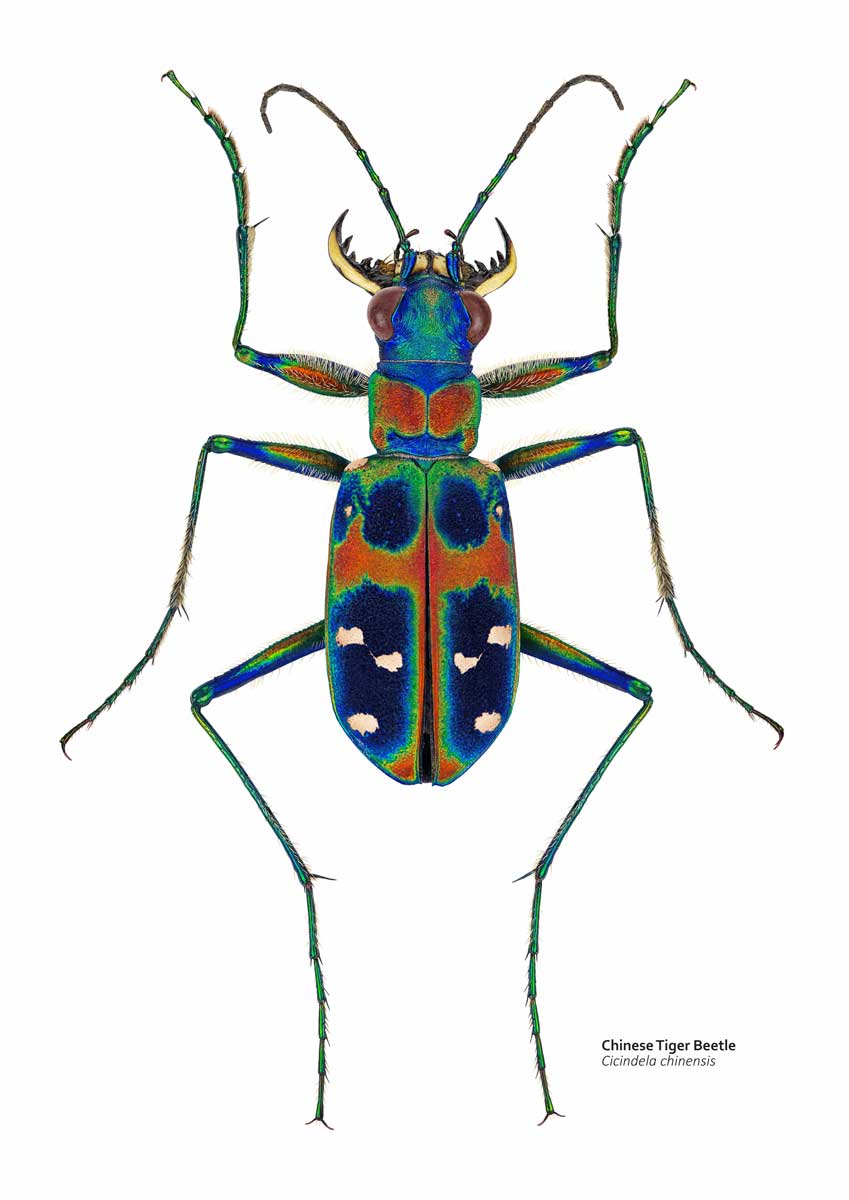
Fittingly, the scientific name of this Chinese Tiger Beetle (Cicindela chinensis) refers to its incredible (and very challenging to draw) metallic colouration – Cicindela roughly translates to “glowworm”. Like many iridescent insects, this shimmering surface is caused not by pigments, but by structural colouration created by the microscopic architecture of the exoskeleton. Light reflects through multiple layers of chitin, with each wave interacting with the others (amplifying or cancelling out) to produce an effect not unlike a film of oil on water.
For an artist like me, the good news is that this iridescence doesn’t fade in preserved specimens in the way pigments often do (something moths suffer very badly from). This meant that by carefully arranging my lights around the specimen, I was able to take a stacked, high-quality reference photograph that demonstrated the beetle’s discoball-like surface. Much like the Iridescent Bark Mantis I drew in early 2025, capturing this shifting metallic sheen was one of the most satisfying challenges of the finished illustration. Viewed from different angles, this beetle’s appearance can shift dramatically from emerald green to coppery red, making it well worth seeing up close if you get the chance.
Another interesting fact about tiger beetles is their speed relative to their tiny stature – they can run up to 125 body lengths per second. This incredible locomotion gives tiger beetles their characteristic stop–start running style: they’ll sprint for a bit and then stop to let their eyes and brain catch up with their new whereabouts. I have adopted a similar running technique over time, albeit with a much less impressive ratio of “starts” to “stops”. And we should probably skip over my personal speed-versus-body-length statistics.
Got a spare wall (or walls. Or wing. Or gallery)? Check out the rest of my ridiculously detailed insect drawings here or in my Etsy shop (this is where, I’m told, you can exchange money for nice things). And now, because I must satisfy the SEO gods*, I should probably mention that this Chinese tiger beetle illustration is available as a high quality A3 or A4 fine art print – which means it could reasonably be described as beetle art, natural history artwork or even an entomology print if you’re feeling particularly scientific.
*or god – I’m not entirely sure if there’s just the one SEO god or a magnificent herd of them.
Take a closer look…

